PHASE 1
History and planning
Target memories, case formulation, arc, and treatment plan goals.
EMDR software for therapists
Rewire Clinical gives trained therapists a focused eight phase workspace, visual and audio bilateral stimulation, arc and SUDS tracking, telehealth support, and a client app for the work you deliberately assign between appointments.
Built for clinical use across EMDR, DBT, somatic, and trauma care.
The week between visits
A client may need resourcing, a familiar grounding exercise, or structured practice connected to work already underway. You assign the arc and control access. Rewire records sets, SUDS, check ins, and client shared reflections, then prepares the relevant context before the next appointment.
Eight phase protocol
Each phase has a place. Prior information carries forward, current set data stays quick to enter, and closure is documented without rebuilding the story every visit.
Target memories, case formulation, arc, and treatment plan goals.
Safe place, container, resourcing, and client readiness.
Image, NC, PC, VoC, emotion, body sensation, and SUDS.
Bilateral sets, SUDS, associations, and feeder material.
Positive cognition and VoC progress tied to the target.
Residual disturbance and somatic observations.
Containment, stabilization, instructions, and current state.
Current SUDS, recent practice, and target status at return.
Client app
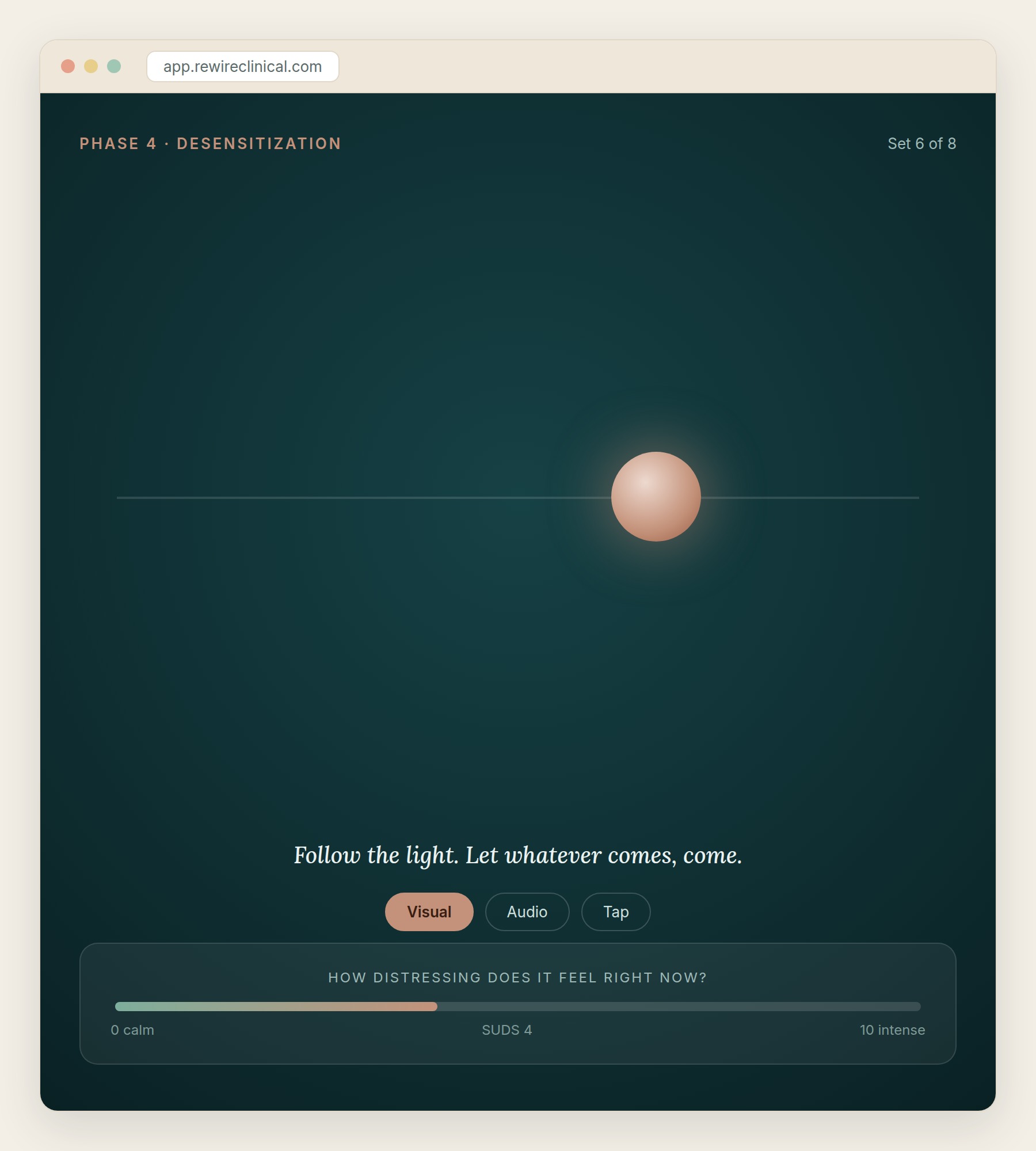
The client opens a workspace you configured, not an endless library. They see the current assignment, complete sets or grounding work, record SUDS, and decide which journal entries to share. You can pause access at any time.

During the appointment
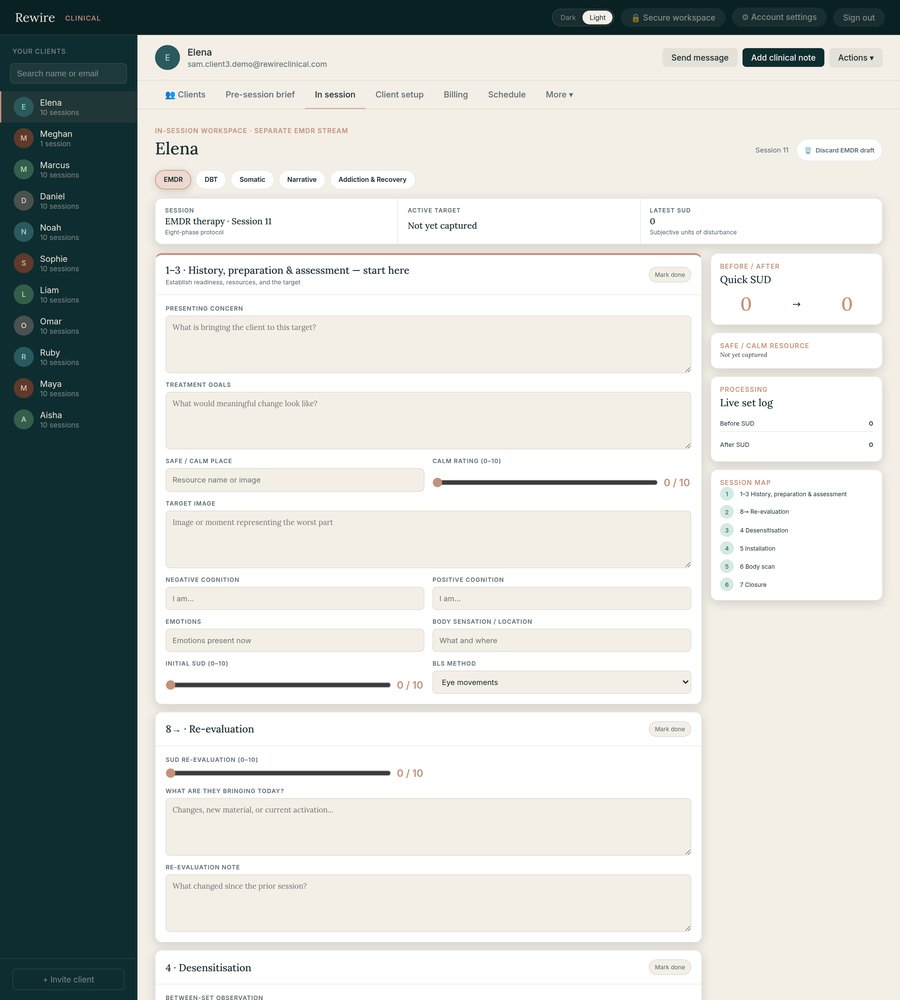
The phase map stays visible without taking over the screen. Record SUDS before and after a set, add associations or feeder material when needed, and move between phases without losing the target. When the visit closes, the structured session record already has the sets, scores, phases, and trend.

More than one modality
Alongside EMDR, clinicians can assign DBT skills, somatic and grounding exercises, narrative prompts, mood check ins, and addiction recovery tools such as craving support and urge surfing. Each client sees only what you enable. Their work returns to the same chart and outcome view.
From EMDR practitioners
“My clients used to come in and I would ask how the week went. Now I already know. Their SUD from Tuesday night and the journal they shared Thursday morning are there. We go straight into the work.”
“The arc tracking is what I did not know I needed. I can show clients the SUDS trend. They can see the work is working, and that keeps them engaged when treatment gets hard.”
“A client who used to cancel when things got hard now opens the app instead. She says it helps her feel that she has a next step. The work continues even when I am not there.”
“Telehealth feels much less improvised. The client has the bilateral display on her own device, while I retain the clinical frame and document each set in the same workspace.”
Connected platform
Visual and audio options for in person, telehealth, and therapist assigned between session use.
Quick set logging, arc trends, reevaluation context, and structured note data.
Scheduling, notes, plans, portal, outcomes, and insurance RCM remain in the same behavioral health system.
Explore more
Take a closer look at remote BLS, assigned exercises, and between session outcomes.
Plain language summary
Rewire Clinical is EMDR software for trained therapists that combines an eight phase clinical workspace, visual and audio bilateral stimulation, SUDS and VoC tracking, client arcs, telehealth support, between session assignments, and connected progress notes. Therapists control what each client can access and review completed activity before the next session.
Questions
Walk through the client arc, bilateral stimulation experience, therapist workspace, and pre session brief.